
Does Your Waste Hauler Actually Recycle Your Plastic “Recycling”? Hard Truths on the High Seas

Standard

If you put out materials for recycling, do you know where they go?

We’ve been recycling for decades, first in California and since 2016 in Indiana. In California, at least where we lived, it was mandatory; we were given three stackable mini-bins to separate plastic/glass/paper and a green waste cart the size of the regular trash cart. In Indiana we pay an extra fee to get our loaded-to-the-gills recycling cart picked up every two weeks, while our nearly-empty trash cart is picked up faithfully every week.

Alert readers may have spotted “high seas” and “gills” and thought: foreshadowing. I invite you to keep paddling. But first, a quick reality check: this is not a climate activism/Green New Deal treatise. To us, recycling is not political. It’s logical, and responsible. It comes from being raised to fix, mend, and reuse things whenever you could instead of, in Mom’s words, “throwing away and buying new.”
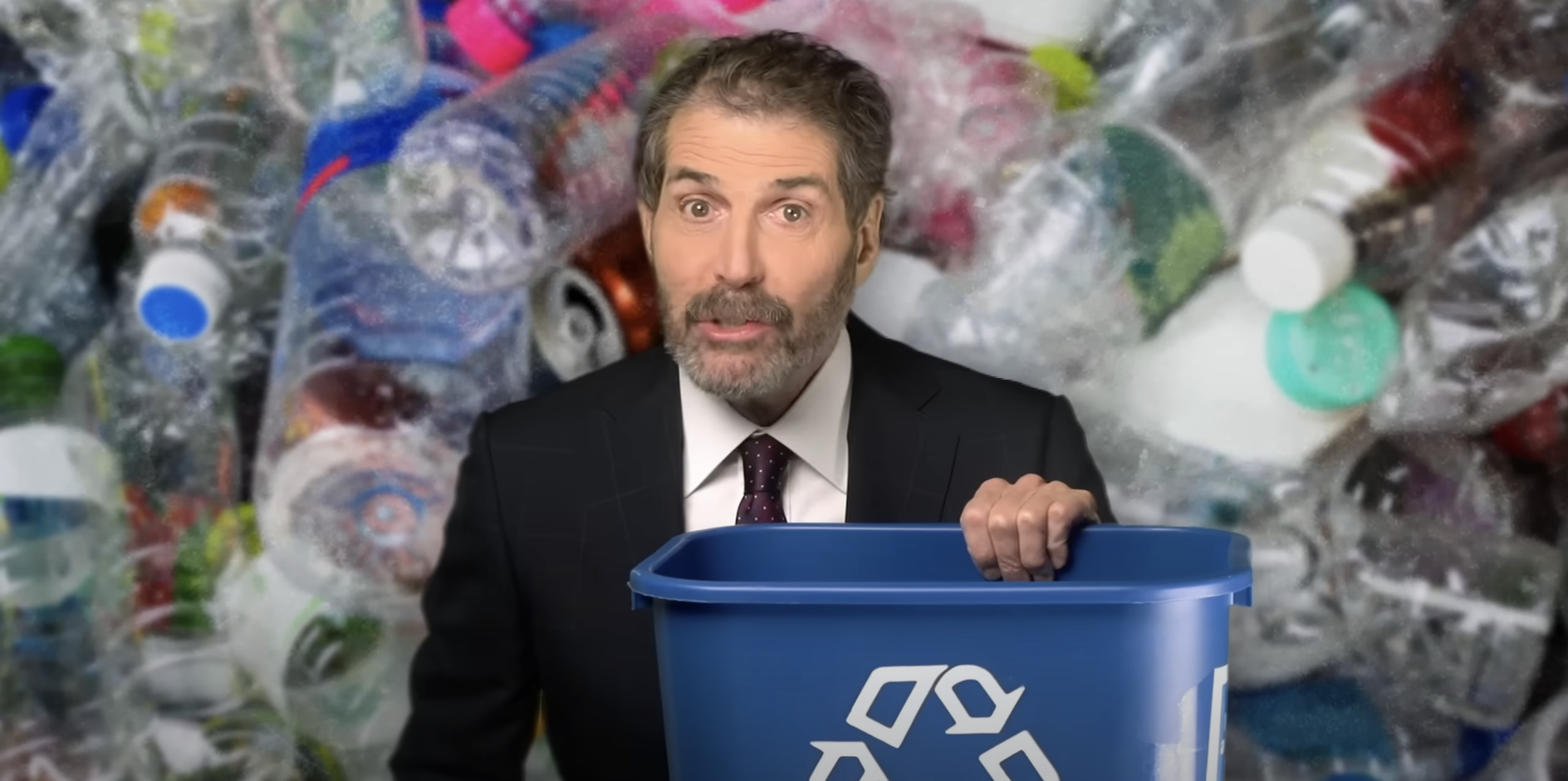
In addition to recycling, another thing we’ve done for decades is enjoy and learn from reports by common-sense independent reporter John Stossel. One of his recent videos showed how companies and countries are shipping plastic “recycling” to various parts of the world, creating plastic mountains on land and floating masses of plastic in the world’s oceans, including…

The So-called ‘Great’ Pacific Garbage Patch

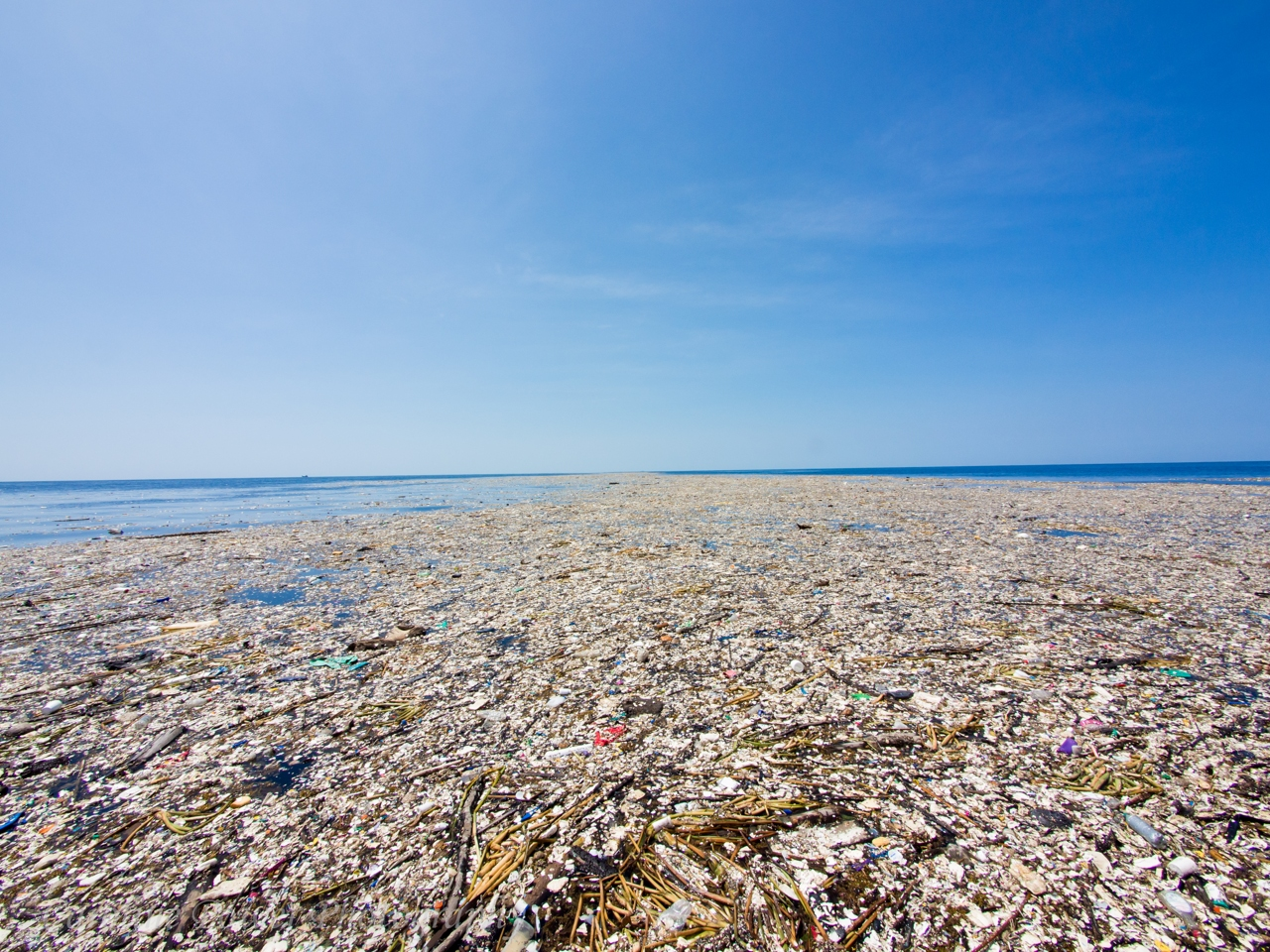
This man-made monstrosity is made up of the ugly, drifting remnants of what passes for human civilization today. Per National Geographic, the Great Pacific Garbage Patch is a murky soup of plastics in the North Pacific Ocean, also known as the Pacific trash vortex.

The Patch actually comprises two sub-patches: the Western Garbage Patch, in Asia-Pacific waters, and the Eastern Garbage Patch off the US West Coast. This bifurcated blight is actually composed of many separate floating islands of plastic and other debris that have loosely coalesced into larger masses.

Accurate 2024 data is hard to come by, but data from 2018 is sickening enough. Researchers from the Ocean Cleanup project calculated, as quoted on Wikipedia, that by 2018 the Patch already covered 620,000 square miles and contained somewhere between 45,000 and 129,000 metric tons of plastic. Years later, by the end of 2024, Ocean Cleanup had removed more than a million pounds of debris from the Patch — which by then was a maddeningly minuscule 0.5% of all that was out there. Some of the plastic in the Patch is 50 years old.

All of this had us ready to start placing our plastic “recycling” in our trash. We figured it was better to force them to deal with it in the US than have it shipped off to strangle fish and birds in the world’s oceans, or pile up in faraway lands.

First we posed some hard questions to our waste management provider. What we learned in a thoughtful, personalized response from Republic Services has us continuing to place plastics in our recycling bin — and trying to connect Republic and Stossel for an interview.

What Republic Services is Doing About Plastics

For material to be recycled, there must be an end market for it: a customer who wants to reuse that material. In the US today, there are robust end markets for PET (plastic #1, such as water or soda bottles), HDPE (plastic #2, such as milk jugs or detergent bottles), and Polypropylene (PP #5, including things like yogurt cups, margarine tubs, and to-go cups). Other plastics, for which there are limited end markets, include flexible plastics like grocery or trash bags, and Styrofoam.

Republic Services operates 75 US recycling facilities that recycled 300 million pounds of plastics in 2024. Republic told us PET, HDPE, and Polypropylene make up more than 90% of the plastics it collects and processes at its recycling facilities. As Republic customers putting these items in our blue cart (which Republic delivery support calls a “toter”), our household plastics are getting recycled, and in North America: Republic does not export plastics overseas.

Next-Level Recycling: Bottle-to-Bottle Circularity

Today many plastics are downcycled into things like carpet, clothing or construction pipe. While this is better than sending materials to a landfill, there are few options for further recycling of these products, so ultimately they become more waste.

It is literally, to borrow an overused political cliche, “kicking the can [or in this case, plastic bottle] down the road.”

To stop recycling from being a one-and-done affair, Republic Services is currently developing a network of plastics recycling facilities it calls Polymer Centers to help ensure bottle-to-bottle circularity: enabling a water bottle to be recycled into another water bottle, a detergent jug to be recycled into a new jug, and so on, to keep the materials within the Circular Economy over the long term. The company began operations at its first Polymer Center in 2023, and as this post goes live it is getting ready to officially open its second one, in Indianapolis, in 2024.

“But Only 9% of Plastics are Recycled. It’s a Losing Battle.”

A frequently cited statistic is the EPA figure that only 9% of plastics are recycled. While this is accurate, it is also misleading, because it refers to all plastic produced, including durable goods like auto dashboards and bumpers, consumer electronics, and medical devices. Those aren’t manufactured to be recycled — at least not through existing, large-scale recycling processes. Republic did not provide insights into what can be done, or what it may be planning, to deal with that other 91%. If I had to bet where a solution will someday be found, though, my money would be on a recycling-forward provider like this one.

Sole-source Recycling (One Cart) is Better. Government Apathy is Not

Other questions we asked were: When are you going to make recycling required in Indiana as it was for us in California? And when are we going to get stackable mini-bins to separate plastic, glass, and paper? The reality is that Republic Services and other waste management companies can’t mandate recycling; they contract with customers to provide the services they choose. Republic noted that Indianapolis is the largest city in the U.S. without regular recycling service, and that city leaders must decide to offer or mandate recycling. We love Indy’s big-city culture, major sports, fine dining, low-hassle airport, and more, without the big-city problems that plague other metropolitan areas, but it is behind the curve on recycling. Living 45 minutes out of Indy, we’re even further off the pace. There is some good news, though: our city now applies a discount to the trash portion of our Republic bill to compensate in a small way for the fact that we choose to pay extra to voluntarily recycle.

CTA: What Are YOUR Waste Hauler and Local Government Doing About Recycling?

What we’ve learned leaves us wondering what other waste management companies and governments in all of the so-called “advanced” nations — those of us who consume the most products and create the vast majority of the world’s plastic waste — are doing about this.
Some of the best pieces of communication leave you with a call to action (CTA). So here is ours: We challenge you, ALL of you, to ask your waste management company and your local government what they are doing about recycling in general, and plastics recycling in particular. That Disastrous Pacific Garbage Patch (my term) isn’t creating itself, and it’s not going to go away on its own. Unless we want our planet to keep going to hell in a Vinylized Plastic Handbasket, we need to push for every bit of household plastics to be recycled, and new processes to pulverize that 91%.

When you find out what companies and leaders are doing, let me know? Send a comment here.

And John, when you have a moment, can you reply to my email? Or call me?

Bitcoin @ $100K: Is Crypto a Currency, an Investment, or a Scam?

Standard

Featured Image credit: FREEPIK

During the 2024 US Presidential campaign, candidate Donald Trump indicated strong support for cryptocurrencies, attended the annual Bitcoin Conference, and even theorized the US might help pay off its national debt with crypto. In the wake of Trump’s election to the Presidency, Bitcoin ($BTC) hit $100,000 per coin (current price here). As always, its sharp rise brought out two competing camps: cheerleaders/profiteers urging investors to “get in now,” and naysayers telling anyone who will listen to keep their (real) money in their pockets because crypto is a scam.

My own take on crypto also offers dual (and dueling) choices. I believe the crypto community can either [1] make Bitcoin or potentially another coin a global standard buyers and sellers can rely on to deliver and hold value in everyday transactions; or [2] continue pushing crypto as an investment vehicle/get-rich-quick scheme. [If you haven’t heard Nikki Glaser’s beyond-hilarious set on the Roast of Tom Brady on Netflix, including the bit of the night about Brady losing millions on crypto, enjoy that killer bit here.]

The first and often only rationale you’ll hear from crypto naysayers is, “It’s not backed by anything.” Reality check: all currencies not backed by a physical element such as gold — like, for example, the world’s currency of record, the USD, since the US took it off the gold standard in 1971 — have value only because people and markets agree they do. So “they’re not backed by anything” is a willfully uninformed reason to cast aspersions at Bitcoin and other cryptocurrencies.

What does feel different to me about Bitcoin is that it seems way less about “being a currency” and way more about “I wanna get mega-rich on Bitcoin like the Winkelvoss twins” of Facebook fame/infamy. Having navigated the whole less-than-scrupulous mystery world of “You’d better get a digital wallet to protect your crypto, if not anyone including us can steal your crypto holdings from any crypto exchange, but wait that’s the wrong kind of wallet” makes it indeed feel like a scam. It also appears designed to discourage the critical mass of normal citizens and consumers from using it as, you know, a currency — TO PAY FOR goods and services.

Crypto has served solely as an investment vehicle for us thus far, a tiny fraction of our holdings, and I’m happy to keep it that way. In a recent year Coinbase stopped dealing in Bitcoin Cash (BCH). This was interesting because we never wanted any BCH, and the only reason we held any in our account was that Coinbase had previously converted another coin into BCH. In Coinbase-Manufactured Transaction #2 — where Coinbase made it impossible to move our BCH elsewhere, liquidated it, and converted it to yet something else — it took a sizable percentage of the proceeds from us for “fees.” I have a life to lead and it wasn’t life-changing money, so the documentation and screenshots lie dormant on file, ready for future action.

This kind of unsavory behavior from Coinbase, and similar conduct by Robinhood, firms that are supposedly safe harbors for non-criminal regular investors, make Theory #3, “Crypto is a Scam,” the leader in the clubhouse.

“It’s Too Hard to Go Vegan; What Would I Eat?” The Ultimate Guide to Plant-Based Tastes

Gallery

[First published in 2019, but an ongoing labor of love updated as recently as February 2022]

To me, “going vegan” was not about being trendy or better-than-thou, showing anyone up, or guilting anyone into doing what I have come to believe is the right thing. It’s just what my wife and I have done in our household after our younger daughter introduced us to it back in 2016.

Below you’ll find links leading to literally thousands of choices ranging from tasty to delicious to downright delectable. In this piece, we:

  • Lead off with the fast-growing lineup of plant-based fare available at restaurants and on the go
  • Move from there to the incredible diversity of plant-based foods ready to tempt your tastebuds on the homefront, including (yes) “The Tesla of Chicken”
  • Follow it all up with Q&A, the science, thoughts, and opinions

A programming note: this post is rigorously sourced, but I couldn’t get references to click to the endnotes for you. Links that simply open to company websites and the like, not part of a news story, are embedded in text. Those sourced from research reports and news stories have a notation, from |a| to |z| and more. Either way, all links open the way God intended them to: in a new tab =;-D At post’s end you’ll find all endnotes with sources, titles, and the same links.

Eating On the Go: Plant-Based Burgers ROCK

These burgers feature something that would surprise those who haven’t tried them: THEY TASTE GREAT. Even if I weren’t a plant-based enthusiast, I would never go back to “regular” burgers.

As reflected in the opening image, we love Beyond Meat Burgers at TGI Fridays. Having had every burger Fridays makes over the years, to us these are the best and tastiest on the menu. We are also proud and happy $BYND shareholders.

Burger King rolled out its Impossible Whopper to rave reviews across the US and Impossible products are available in a handful of other countries. Beyond Meat products have far greater reach, currently sold in the US parts of EMEA, APAC, and Latin America. Both companies are of course looking to expand into other markets. Continue reading

Mac Links LIVE!

Gallery

For I think 10-15 years now I’ve been using the Office suite on PC to make PDFs of Word, Powerpoint, and Excel files and never gave links a second thought. You embed links in text like this in the source file and they’re live in the PDF. Fonts and layout are identical to what you created in the source file.

Not on Mac.

Oh, if you simply type out links as text, e.g., https://www.crunchbase.com/person/jeff-cotrupe, they do save as live links in PDFs. But it is self-evident why that is sub-optimal. Pretty much everywhere in all applications people embed links in all content like this, and that is the standard.

Create a file in Office on the Mac, save as PDF and you’re presented with two choices:

  • Saving your PDF as “Best for printing” preserves fonts/layouts but kills the links.
  • Saving as “Best for electronic and accessibility (uses Microsoft online service)” gives you live links, but is also dependent upon which fonts Microsoft has loaded on those servers. In any file I’ve ever tested, this method massacres fonts and layouts and is unworkable.

After much experimentation and testing, here are the only two ways you can use Word on a Mac to create PDFs with embedded live links AND the fonts and layout of your choice:

[1] Use Word for Mac to create your doc. Save as Best Print Quality. Your embedded links are dead. Buy Acrobat Pro DC for $450 or license it for a year for $180. Open your PDF and the source Wordfile. Copy link locations for all links in Wordfile and paste them in into new link boxes you create over those same words or phrases in PDF.

[2] Buy Parallels, Windows 10, and Office for your Mac. Parallels virtual machine frees Word to do on Mac what it does on PC: save embedded live links in PDF. Not sure what it cost my company to buy Parallels and Windows 10 licenses, and the new separate license for Office to use in Parallels.

Long way and lot of money to go just to create live links AND not demolish your fonts and layouts when saving Word to PDF on a Mac, right? But those are your choices.

I bet Microsoft, Apple, and Adobe could get together and fix this in a New York (or Seattle, or Silicon Valley) minute. But there’s a lot of money changing hands in #s 1 and 2 above, so…

A life well lived: I finally made it into the New York Times

Gallery
NY Times Biz masthead
1st guy, seeking directions on a New York City street: “How do you get to Carnegie Hall?”

2nd guy: “Practice, practice.”

In my past work in marketing and public relations I’ve gotten a client or two placed in the New York Times, but now my own name appears in “those hallowed halls”–which is a phrase I reserve for those pages where the Times is not trying to tell us how we should all feel about politics. No, these are the informative-and-topical hallowed halls of the Times. A Travel feature in the Business Day section.

And wow, it’s a WHOLE paragraph. At the very end of an article. But it IS the New York Times. When you get your name in the Times, you salute the flag and say, “Thank you, Sir, may I have another [mention in the Times someday]?”

Typical for a major media outlet, the person who interviewed me spoke with me for about a half-hour, yet most readers can polish off my Paragraph of Fame in seconds. Did I tell them who I work for, and provide my title, and spell it all out for the interviewer? Yes. Did I ever once say I was “a business consultant”? No. But again..it’s…the New York Times.

And they spelled “Cotrupe” correctly. MAJOR bonus points for that.

Here’s the link to my moment in the sun. Enjoy.

“Dropped 40 pounds in a year, Jeff? How did you do it?”

Gallery

UPDATE: -47 pounds and counting | The world is my treadmill…

Me: November 2011 Me: November 2011

In the months leading up to my Grissom High School Reunion in July 2012, I knew I wanted to do something to get in shape. When our younger daughter Heather returned home from college for the summer, she suggested juicing: blending fruits and vegetables in a specially-made juicing machine, and drinking the juice as a meal replacement. So we did that juicing “cleanse” for a month before the Reunion.

Two dear lifetime friends were, in my eyes anyway, the hit of the Reunion: Karen Cass Gill and Carol Baldwin Butterworth. Karen is in amazing shape, and you know those long distance runners from Kenya who compete in the summer Olympics? Well, Carol was in better shape than anyone I’ve ever seen other than, pretty much, those runners from Kenya.* Carol is Association Director Of Youth Teen and Families for a network of YMCAs in Virginia, and here’s what she said about it: “If I’m telling everyone to get in shape, how can I be anything less?” Everyone at Reunion marveled at her. A few days later, done marveling (at least for the moment), I asked her what she does to stay in such, um, marvel-ous shape. She told me several things, but the most important one was this: “I try to always get my 10,000 steps a day.”

I’ve worked in my home office for years, and at that point I figured I was probably getting, oh, 400 steps some days. I also knew that…

Continue reading

TM Forum publishes my “Let’s Make it a Good (Mobile and Web) Experience”

Standard


Hello again. TM Forum, the world’s leading industry group/consortium on all things network management, published a little piece I did on what mobile and website operators (everyone from AT&T, Verizon and Telecom Italia Mobile to Amazon.com) are doing to see not just that their own networks and sites are “up” but what WE are experiencing as users, and how to fix it. The piece appears in the Forum’s Inside Leadership newsletter; invite you to read more if you like here. Continue reading

Is Facebook the new email?

Standard


We’ve certainly discussed the pros, cons and security angles around Facebook here and here, and as promised we’ve been adding useful links to one of these, our Facebook Privacy page. Worth mentioning in passing but today I’m thinking more of another entry, Is Social Media Really Bankable, that cited examples of how some of the largest companies in the world—and maybe yours—are starting to leverage social media to build their businesses.

Bloggers normally look outward for suitable subject matter, but in this case my own tendencies have caused me to question whether we’re part of a larger trend. Continue reading

Mobile advertising is on the move

Standard
This blog entry also appears here

Ty Wang, senior director of product marketing for service delivery solutions at Oracle, posted an entry on the Open Communication Blog at Billing & OSS World touting a Gartner forecast that mobile advertising will generate billions of dollars in revenue by the year 2013. Ty asked a great question, in effect, these figures sound great, but what if anything is really happening in the market? Who’s doing this? As the animated hologram told Will Smith’s character in the movie I, Robot: “THAT, detective, is the right question.” Some big (and small) players are making important things happen that are building the foundation for that promised market growth. Continue reading