Bitcoin @ $100K: Is Crypto a Currency, an Investment, or a Scam?

Standard

Featured Image credit: FREEPIK

During the 2024 US Presidential campaign, candidate Donald Trump indicated strong support for cryptocurrencies, attended the annual Bitcoin Conference, and even theorized the US might help pay off its national debt with crypto. In the wake of Trump’s election to the Presidency, Bitcoin ($BTC) hit $100,000 per coin (current price here). As always, its sharp rise brought out two competing camps: cheerleaders/profiteers urging investors to “get in now,” and naysayers telling anyone who will listen to keep their (real) money in their pockets because crypto is a scam.

My own take on crypto also offers dual (and dueling) choices. I believe the crypto community can either [1] make Bitcoin or potentially another coin a global standard buyers and sellers can rely on to deliver and hold value in everyday transactions; or [2] continue pushing crypto as an investment vehicle/get-rich-quick scheme. [If you haven’t heard Nikki Glaser’s beyond-hilarious set on the Roast of Tom Brady on Netflix, including the bit of the night about Brady losing millions on crypto, enjoy that killer bit here.]

The first and often only rationale you’ll hear from crypto naysayers is, “It’s not backed by anything.” Reality check: all currencies not backed by a physical element such as gold — like, for example, the world’s currency of record, the USD, since the US took it off the gold standard in 1971 — have value only because people and markets agree they do. So “they’re not backed by anything” is a willfully uninformed reason to cast aspersions at Bitcoin and other cryptocurrencies.

What does feel different to me about Bitcoin is that it seems way less about “being a currency” and way more about “I wanna get mega-rich on Bitcoin like the Winkelvoss twins” of Facebook fame/infamy. Having navigated the whole less-than-scrupulous mystery world of “You’d better get a digital wallet to protect your crypto, if not anyone including us can steal your crypto holdings from any crypto exchange, but wait that’s the wrong kind of wallet” makes it indeed feel like a scam. It also appears designed to discourage the critical mass of normal citizens and consumers from using it as, you know, a currency — TO PAY FOR goods and services.

Crypto has served solely as an investment vehicle for us thus far, a tiny fraction of our holdings, and I’m happy to keep it that way. In a recent year Coinbase stopped dealing in Bitcoin Cash (BCH). This was interesting because we never wanted any BCH, and the only reason we held any in our account was that Coinbase had previously converted another coin into BCH. In Coinbase-Manufactured Transaction #2 — where Coinbase made it impossible to move our BCH elsewhere, liquidated it, and converted it to yet something else — it took a sizable percentage of the proceeds from us for “fees.” I have a life to lead and it wasn’t life-changing money, so the documentation and screenshots lie dormant on file, ready for future action.

This kind of unsavory behavior from Coinbase, and similar conduct by Robinhood, firms that are supposedly safe harbors for non-criminal regular investors, make Theory #3, “Crypto is a Scam,” the leader in the clubhouse.

I’m a CMA Top 100 Influencer & Strategist

Standard

So honored! I’m a CMA Top 100 Influencer & Strategist for 2024. Grateful to the amazing customers, partners, and colleagues who make it all possible! Thank you to everyone at Base (formerly Crowdvocate) for making this possible. Base’s mission is to maximize revenue through engagement by taking your customers and teams on a journey for higher retention, lifetime value, and advocacy.

A Plan to Stop Mass Shootings and All Violent Crimes Dead in Their Tracks

Standard

I have detailed thoughts supporting each of these, but we live in an era of TL:dr. So to encourage you to read this, and maybe to care and act, here are the key points of the plan:

1) Make the death penalty the law of the land for any violent crime, which I hereby define as child sexual abuse and up, regardless of the age of the assailant. No plea deals.
[Federal law]

2) Eliminate or supersede laws that prevent the state from helping the mentally ill if they or their families “don’t want to be helped.”
[Federal law]

3) Force schools to address the serious bullying that has provably and directly led to a number of these shootings. Schools who ignore issues and do not immediately engage law enforcement face legal action.
[Federal-state-local action]

4) Enact serious gun control including a ban on all semiautomatic weapons and high-capacity ammunition — not just AR-15s but any handgun or long gun that shoots many rounds in seconds — and a mandatory federal buyback program to compensate owners for the multitude of these weapons that are already in the field. “Then only criminals will have them”? See #1 above.
[Federal law]

5) Make parents financially and legally responsible if any immediate family member ever commits a violent crime.
[Federal law]

6) Return freedom of voluntary (not mandated) prayer to the schools and all public places.
[Federal law]

7) Return the every-morning Pledge of Allegiance to schools.
[Federal law]

8) Ban assault media. Get serious about banning or seriously limiting violence in all forms of entertainment from gaming to TV to movies to music.
[Federal law]

9) Install metal detectors at the doorways of schools, malls, theaters, and other currently-unprotected public venues.
[Federal-state-local action, public-private partnership]

10) Hire expert marksmen/sharpshooters for all schools, malls, movie theaters, and other currently- unprotected public venues.
[Federal-state-local action, public-private partnership]

11) If anyone breaks into any public or private place, or even without breaking in pulls a weapon on anyone in any public or public place, any citizen and anyone acting on their behalf has the right to injure or kill the threatening party without being prosecuted.
[Federal law]

12) No one who is hurt or killed while they themselves were in the commission of a criminal act as described in #11, nor their families or friends, nor anyone else on their behalf, shall be allowed to bring a lawsuit or negative action of any kind against those who hurt or killed the criminal.
[Federal law]

13) Provide tax breaks and vouchers so every family everywhere is free (and supported) to choose homeschooling or charter schools instead of public schools.
[Federal law]

14) Ban movie or book deals, or any form of compensation that originated from a violent crime, to the criminal and his or her family as far as their family tree goes, any friends or associates, or anyone acting on his or her behalf.
[Federal law]

15) Restrict media mentions of the names of those who perpetrate mass shootings to only once on each media entity’s first mention of the crime.
[Federal law]

Your data needs to keep up with the state of play today. Event-driven architecture will get you up to speed

Gallery

The Pop-Up Playground Party at AWS re:Invent 2019, sponsored by MongoDB and Confluent, was an exclusive, interactive event featuring immersive art, light, gaming, and play activations with an open bar, DJs, and more, at the Industrial Las Vegas.

Attendees got to create unforgettable memories (or at least killer Instagram photos) at the glowing ball pit, DIY graffiti walls, retro arcade games, and other immersive activities, such as getting a temporary tattoo in a sports car. Meanwhile, the Hood Internet and Vegas’s hottest DJs kept the soundtrack fresh all night long!

In a word, the Pop-Up Playground was: fun.

Something that is way less fun: being one of the many companies that increasingly find it impossible to keep up with the pace of business because their data platforms can’t keep up. Under those circumstances life is anything but a party, in fact, the opposite of a party. 

That’s why MongoDB and Confluent teamed up, not just to throw the best party at re:Invent but to help companies run their businesses in real time. 

An effective approach to real time could not come at a better time, because many companies are still trying to meet their data needs in ways that don’t match modern business reality. Some are mired in 40-year-old relational database technology. Others think updating to a NoSQL database is positioning them for the future. They soon learn that while getting data in may be easy enough, getting insights out is a whole different story, and what they are actually positioned for now are niche applications, not an effective new data strategy.

The results of pursuing the wrong data strategy can be harmful or fatal. CNBC Markets found that the average lifespan of S&P 500 companies has fallen from nearly 60 years in the 1950s to less than 20 years today. Innosight modeled the rate of attrition from the S&P 500 and predicted that over the next 10 years, half the companies will be replaced: drop out, go out of business, or be acquired, as digital transformation lowers barriers to entry for new players and helps drive out incumbents trapped in legacy infrastructures and processes.

The traditional request-driven data architecture that still exists at many companies helps keep them trapped in legacy limitations. It requires users and applications to make requests and wait until the requested information becomes available. Waiting for data kills opportunity and agility.

By contrast, event-driven architecture, which I posted about on jeffcotrupe.com,  proactively makes a stream of data from source systems (producers) available in real time. Consuming applications and services (consumers) subscribe to topics of interest and consume data at their own pace. Capturing and acting on events in real time enables systems to react automatically and immediately to events. This helps a company rapidly position itself to outflank competitors. Detecting operational errors lets it take immediate corrective action. These benefits translate into not only operational excellence and cost savings but also enhanced customer experience as the company optimizes customer-facing processes. More broadly, an event-driven architecture helps the organization improve business agility.

The key driver today in making the need for real-time data an organizational imperative is the emergence of microservices. Microservices architecture breaks up monolithic applications into small, discrete services or functions. It creates self-sufficient sprint teams empowered to bring new capabilities online independently of each other, then over time evolve and upgrade their microservice without impacting adjacent microservices. That is the essence of agility.

As beneficial as microservices can be, though, they require the ability to work with large volumes of data that change frequently, which is a challenge many existing systems cannot meet. Trying to implement microservices in a legacy relational database incurs the pain and friction of having to define a schema in the database and re-implement that same schema again to effect object-relational mapping (ORM) at the application layer. Then your development team has to repeat the process, first for each microservice and then every change to the data model as application functionality evolves.

With MongoDB, data modeling for microservices is easy, which is a big reason MongoDB is at the core of many event-driven systems today. MongoDB’s flexible document model gives you the best way to work with data, lets you intelligently place data where you need it (and when, as in immediately), and gives you the freedom to run anywhere. MongoDB helps you move at the speed your users demand. It gives you the power to launch new digital initiatives and bring modernized applications to market faster, running reliably and securely at scale, unlocking insights and intelligence ahead of your competitors.


 

By starting with the core MongoDB data platform and binding in complementary technologies, MongoDB provides the data persistence heart of an event-driven architecture. MongoDB and Confluent work together to enable you to readily build microservices and event-driven architectures to become an agile organization.

Confluent Platform, including Apache® Kafka® and Kafka Connect, is designed as an event messaging queue for massive streams of data that sequentially writes events into commit logs, allowing real-time data movement between your services and data sources. The MongoDB Connector for Apache® Kafka® — developed and supported by MongoDB engineers, and verified by Confluent as a first-class component of Confluent Platform — simplifies building robust, reactive pipelines to move events between systems. You can use MongoDB as a sink (consumer) to ingest events from Kafka topics directly into MongoDB collections, exposing the data to your services for efficient querying, enrichment, and analytics, as well as for long-term storage. You can also use MongoDB as a source (producer) for Kafka topics; in this mode, data is captured via Change Streams within the MongoDB cluster and published straight into Kafka topics. These capabilities enable consuming apps to react to data changes in real time.

MongoDB-powered event-driven architectures are at work in a range of user cases including IoT and other time series applications; financial services; AI; predictive maintenance, primarily in manufacturing but also in other verticals; Web activity tracking and log aggregation; and as an operational data layer (ODL) integrating and organizing siloed enterprise data to make it available to all users and consuming apps. Customers who have deployed event-driven architecture powered by MongoDB include Ticketek, EG, ao.com, Man AHL, and comparethemarket.com

The figure below shows MongoDB and Confluent working together in an event-driven architecture supporting a microservices-based e-commerce application.

In this scenario, fuel costs to ship some items have just gone up, which could impact pricing. This produces events about the cost increase and places them into Apache Kafka. The Pricing microservice consumes the event, analyzes it against existing data, and produces events conveying the new pricing. MongoDB Atlas captures this data and, through the MongoDB Connector for Apache Kafka, publishes it into Kafka topics, which makes the data available to all consumers. Microservices directly impacted by pricing changes, such as those that manage inventory, marketing, promotions & coupons, point of sale (POS), and the e-commerce provider’s order management system (OMS), consume the price change events and update their individual databases accordingly. MongoDB Atlas aggregates and persists data from all microservices, enriches event streams with data from other sources, including historical data, and provides a central repository. This enables applications and users to benefit from all data across all microservices and provides a unified view of state across the e-commerce provider’s enterprise.

To learn more, download our white paper, How MongoDB Enables Real-Time Data with Event-Driven Architecture, and visit our Real-Time Analytics page.

WELCOME to a more competitive e-commerce market

Gallery

Attended the eTail West event two years running…placed two online orders during roughly the same period with a company I lovingly dub the Retail Death Star…had a deadline to meet for the IDG Infoworld blog…and it led to one of my most fun-to-write blog posts ever. The WELCOME mat above plays a pivotal role in the piece, but IDG wouldn’t run this photo because it doesn’t publish anything but its own internally approved pix. So here it is in all its boldly leaf-strewn glory, beckoning you to walk right over it and enjoy all the e-commerce action here.

Before I go: some of the arboreal wonders giving the mat that leafy look.

Innovating for Dollars: AI / ML / Deep Learning / Cognitive for Financial Institutions

Gallery


When Letterman was still hosting the Late Show, from time to time he’d say: “And if all THAT weren’t enough…and by golly, don’t you think it ought to be,” and would go on to mention something else that was noteworthy about the show or a guest.

Bear with me, I’ll go back to that in a moment, and it will tie into our discussion…which is about AI. AI is forecast to drive GDP gains of $15.7 trillion globally by 2030.* No organization can afford to miss out on its share of those trillions in opportunity. Adoption is low thus far, however. In Stratecast’s 2017 Big Data and Analytics Survey, only 20% of organizations said they are considering, planning, implementing, or using it. We think one part of it is market confusion; another is organizations not seeing the link between AI and revenue—both growth and retention.

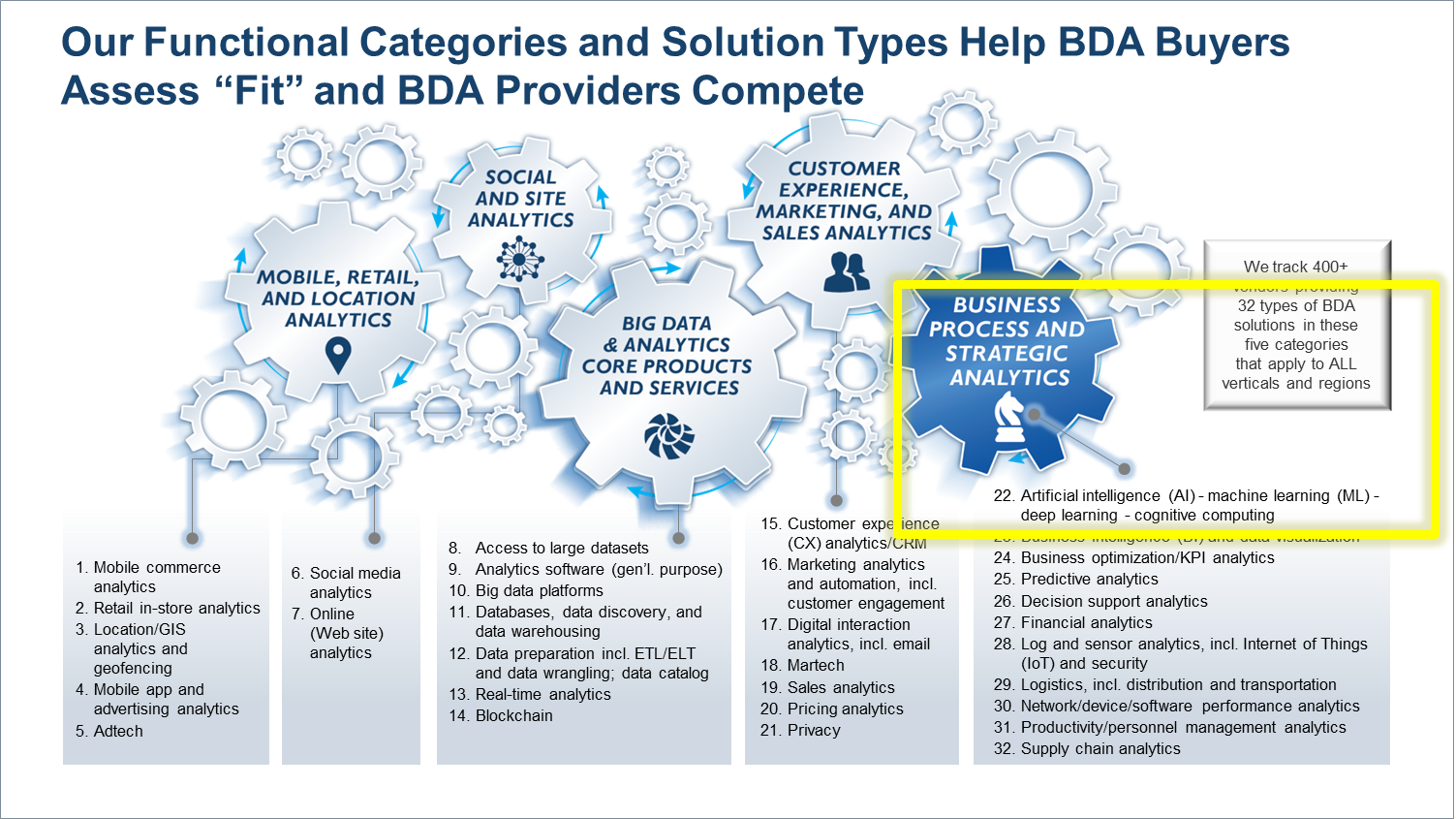
Let’s first dispel some confusion surrounding AI. My practice analyzes big data and analytics (BDA), and here is where AI fits at a functional level: the Business Process and Strategic Analytics (BPSA) area of the BDA market. BPSA represents about one-quarter of the overall BDA market, which we assessed at more than $53 billion in 2017, and which we forecast to grow to nearly $68 billion by 2019.

Now let’s talk about other linkages between AI and money. Ever heard of Alexa and Siri? Amazon? Facebook, Google, Netflix, Tesla, and Uber? These and a multitude of others are making money right now by applying AI to their businesses. But wait, you say, what about financial institutions? Well, how about one of the largest online financial trading services in the world? It has used AI to reduce support costs by 80%. Or consider how, with hundreds of forms and more than 350 online apps, associates at a top-10 Wall Street investment firm were spending an average of 20–30 minutes looking for each form or app. The firm is now saving an estimated $32 million annually by applying AI to those and related processes. Even these examples, however, reflect a financial services market that is only beginning to scratch the surface of all the ways AI can benefit financial institutions. Customer-facing applications of AI include learning customer patterns and motivations to help guide them toward better financial decisions. In the back office, AI can, similarly, guide a financial institution’s own investment decisions. AI can automate tasks in many areas including underwriting, reconciliation, the development of risk models, and basic handling of incoming data and queries.

Sounds good, right? But delivering on the promise of AI requires a vision for applying smart analytics to the business. Nowhere is that concept more fitting than when talking about Tableau. Tableau provides the foundation underpinning the adoption of new and emerging technologies with an enterprise platform that covers all the bases in governance and security to help financial service companies guard against security breaches and ensure privacy compliance. Tableau offers rapid performance against massive datasets, an effect now accelerated by Hyper, its fast main-memory database system designed for simultaneous OLTP and OLAP processing (transactions and analysis in a single system) without compromising performance. Powerful, self-service analytics drive innovation, encouraging employees to discover opportunities for new products and services, contributing to customer and revenue growth—and enabling them to quickly run scenarios to assess the impacts of new business models such as blockchain.

Back to Letterman: “And if all THAT weren’t enough…and by golly, don’t you think it ought to be,” Tableau also has a vision for smart analytics that transcends AI-supporting BDA firepower with some pretty impressive AI building blocks. On the NL front, Tableau acquired Cleargraph and is combining Cleargraph’s NLP capabilities with Tableau’s existing Eviza natural language interface; and the company has partnerships with Automated Insights and Narrative Science to add NLG capabilities to the mix. In development are Tableau’s new Recommendations Engine, which will enable discovery, help users reuse the work of others, and leverage knowledge of their communities; Model Automation, which will offer smart defaults, saving time and providing ease of use; and Automated Discovery, to help customers discover hidden insights and answer more complex questions.

Planning on revenue growth? Failure to harness the power of AI could be a showstopper. Tableau has the content and the connections to ensure that the show will go on.

*PwC, AI to drive GDP gains of $15.7 trillion with productivity, personalization improvements, available here

“Dropped 40 pounds in a year, Jeff? How did you do it?”

Gallery

UPDATE: -47 pounds and counting | The world is my treadmill…

Me: November 2011 Me: November 2011

In the months leading up to my Grissom High School Reunion in July 2012, I knew I wanted to do something to get in shape. When our younger daughter Heather returned home from college for the summer, she suggested juicing: blending fruits and vegetables in a specially-made juicing machine, and drinking the juice as a meal replacement. So we did that juicing “cleanse” for a month before the Reunion.

Two dear lifetime friends were, in my eyes anyway, the hit of the Reunion: Karen Cass Gill and Carol Baldwin Butterworth. Karen is in amazing shape, and you know those long distance runners from Kenya who compete in the summer Olympics? Well, Carol was in better shape than anyone I’ve ever seen other than, pretty much, those runners from Kenya.* Carol is Association Director Of Youth Teen and Families for a network of YMCAs in Virginia, and here’s what she said about it: “If I’m telling everyone to get in shape, how can I be anything less?” Everyone at Reunion marveled at her. A few days later, done marveling (at least for the moment), I asked her what she does to stay in such, um, marvel-ous shape. She told me several things, but the most important one was this: “I try to always get my 10,000 steps a day.”

I’ve worked in my home office for years, and at that point I figured I was probably getting, oh, 400 steps some days. I also knew that…

Continue reading

The Relay of Your Life

Gallery

The TRUPERS at Relay For Life, Oceanside, CA, USA, 04/20/2013

The TRUPERS at Relay For Life, Oceanside, CA, USA, 04/20/2013

Everyone has their causes and things they support, and whatever you do that is positive, you’re making the world a better place. So I’m not here to preach or sell. What I will say is that if you’re looking for a fun, positive, low-pressure event that helps to save lives, I highly recommend the American Cancer Society’s Relay For Life. I’ve written about it here, here, and here, so I won’t reinvent the wheel in this post, but it is one of the most worthwhile things I’ve ever done. Continue reading

Newtown calls for new answers | Introduction & Part 1

Standard

532611_10151321302367240_61073717_n

A dear cousin has a childhood friend whose daughter attends Sandy Hook Elementary in Newtown, Connecticut, USA. As I understand it, their young daughter was home sick on that fateful day, just before Christmas 2012, when a cowardly, misguided and, we learned, likely mentally deranged gunman sent 26 souls, 20 of them children, to Heaven.

If there is a God and if anything I have ever learned in my life means anything, when that gunman gutlessly turned the gun on himself, he sent his own soul to hell. I continue to petition our Lord and Savior to allow me 26 minutes in that inferno, one for every victim, to address the gunman directly and personally.

My cousin’s friend’s entire family is now sick themselves: sick with sorrow knowing they were spared the Newtown tragedy while so many they care about were not.

I am sick over this myself. Not because a friend of a close relative is at ground zero of this horrifying nightmare, although that certainly brings it closer to home. No, it is because while this cowardly, evil gunman acted alone, and in that sense he is the only one to blame for those 26 beautiful souls being swept from this earth, the factors that have brought us to this place as a nation — where it would now be a shocking week that did not include a shooting at a public place — make clear that in many ways, he did anything but act alone. In this situation, and so many sickening others at schools and malls across the U.S., it appears that things “fell through the cracks.” And while so many people in my lifetime have spoken those words to me, it seems as if we as a nation are so busy covering our political asses that we are letting this nation’s lifeblood and future fall through the cracks.

Partisan “Answers” Are What Got Us Here in the First Place

I am a registered Independent. Not because I’m “on the fence,” or indecisive, or don’t have an opinion. Actually, as you may learn if you bravely read on, I’m one of the most decisive people you may ever encounter, rabidly unafraid to stake out a position. No, I am a registered Independent because I simply cannot sell my political soul to one side or the other. You know the “sides”: Democrats versus Republicans. Liberals versus conservatives. Is our democracy at its core about the right of free speech, and more broadly than that, free ideas? You bet it is. Is robust debate a healthy ingredient in our democracy? Yep again. Yet here is what I believe had better STOP being a part of our democracy, this noble experiment, this shining city on a hill: this business of far too many Americans waking up every day “already knowing who they hate.”

…and my point is? Simple: if you’re reading along expecting someone who cannot wait to pounce on Newtown and other tragedies for partisan political advantage, you can forget it. If you hope to add partisan politics to it, through the kinds of vicious comments that make their way onto some of talk radio and The Daily Kos — well, daily — I have the only vote that counts when it comes to posting them here. Frankly, I am sick of it, and about it. Let the well-funded, entrenched idiocracies keep right on being part of the problem, creating and reinforcing political gridlock: the any-gun-for-any-reason NRA lobby, the every-criminal-has-a-heart-of-gold apologists, the any-abortion-at-any-time NOW lobby, the everyone-is-a-victim lobby. They’re all happy to keep “doing their worst”* to keep tearing this nation apart, and they’re doing a killer job of it.

282584_10151317946307240_2117344056_n

I live by this crazy principle, in political matters and all things: “Don’t tell me who you are. Show me what you DO.” We need all the great ideas, specific plans, hard work, and action we can get, or we’re not going to survive as a nation. The Chinese, the terrorists, the global economy are not going to wait around for us to figure this out. As Bill Clinton once said: “We don’t have a single person to waste.” And as a great many have said over our history: “time’s a wastin’.”

So on with the plan. Below is part 1:

GUNS AND PROTECTION OF FAMILY AND LIVELIHOOD

1) Immediate need: tighter gun control, and a ban both on assault weapons and the high-capacity ammunition they use. Federal law. We were at long last smart enough as a nation to end the idiocy of “drinking age 21 in this state, drinking age 19 in an adjacent state” that sent underage drinkers speeding across state lines to their death, and causing the deaths of untold others. Let’s figure out what we can all agree on and get it done. This business of “We’re not gonna enforce any gun control laws here in our county if we decide they’re unconstitutional”: hey, have the balls to go ahead and secede from your state, or the Union. As long as you’re part of THIS household…I mean, nation…you obey our rules.

2) If anyone breaks into your home or business, or pulls a gun or knife on you or anyone in your home or business, you or anyone acting on your behalf has the right to injure or kill them without being prosecuted for it. Federal law. Banning assault weapons and placing other limits on guns also removes a deterrent: witness gun-free zones such as schools and college campuses where most of these senseless mass killings are occurring; and much larger “zones” where it is illegal to carry a gun, such as, um, New York City. Right now killers know they are operating from a position of power against defenseless victims. It is time to take back the power.

3) Redefine the ridiculously limited current notion of “self-defense.” Federal law. Self defense is no longer to be construed as, “he was coming at me with the threat of immediate death or serious bodily harm to me — but if he stops, or turns away, I cannot do anything to him.” Let’s get real and stop pretending we don’t know what we all know: that anyone who would threaten violent death on others will be back. We are perfectly within our rights to eliminate that person so they will never again bring harm to us, our loved ones, or anyone else. We are under no obligation to stand by and wait ’til they come back to finish the job.

4) No one who is hurt or killed while they themselves were in the commission of a criminal act, nor their families or friends, nor anyone else on their behalf, shall be allowed to bring a lawsuit or negative action of any kind against those who hurt or killed the criminal. Federal law.

The cumulative effect of the changes in this first section, provisions 1-4, would be to show that we actually are serious and thoughtful enough not to simply place any weapon in anyone’s hands for any reason — while at the same time letting anyone contemplating a violent criminal act know that they are not cleverly preying on innocents. Instead they will know clearly that if they break into or otherwise enter anyone’s home or business with intent to commit a criminal act, it may well be the last thing they ever do.

* Thank you, Monty Python troupe

!mB for animation

“Newtown calls for new answers” is a five-part blog series, each of which focuses on specific areas I believe we must address, together, to help stem the rising tide of violence in America.

Introduction & Part 1 | NEXT: Part 2 | Part 3 | Part 4 | Part 5 & Conclusion

My pilgrimage to the musical motherland: U2

Standard

…and other dispatches from Dublin during Management World 2011

Aye and Begorrah. The week I traveled to Ireland, President Obama did as well. Honestly not sure why he did not consult with me to sync up schedules…at any rate, the big news of the week for me professionally was attending an event-within-an-event, featuring the team I lead at Stratecast, at the world’s largest IT show for the communications industry. The Innovation Spotlight at Management World 2011 was built around the Rat Pack/10 to Watch report our team publishes each year identifying and analyzing the market’s hottest emerging companies. Check out some great videos from the event here.

Management World (MW) was chock-full of meetings each day plus working breakfasts and dinners, but in a few brief free moments I was able to snap a decent pictorial’s worth of pertinent pix. Continue reading