
A post is making the rounds on social media about Social Security and Medicare suddenly being called “Federal Benefits.” Apparently not true—it seems they’ve long been referred to as Federal Benefits—and the media have helpfully pointed this out in articles that come up on search.
BUT HERE’S THE THING: I care less about how the government categorizes these programs, or angry social media posts, and more about the substance of the issue. Let’s dive in.
What’s the rumor
The crux of issue, according to the post and a multitude of reposts, is that:
- The Federal government, or more to the point, the Social Security Administration (SSA), takes a combined 15.3% out of your pay Social Security & Medicare. (15.3% is the 2025 rate; it has varied over the years)
- If your earnings averaged $30,000/year for 40 years, you and your employers will have contributed about $180,000.
- If the government had put that money into a safe investment earning even 1%, at the end of 40 years you’d have $1.3 million to retire on.
- Upon retirement, if you took out only 3% per year, you’d receive $39,318 per year, or $3,277 per month. That’s not far from 3x today’s average Social Security benefit of $1,230 per month, according to the SSA.
This doesn’t math out for me.
- I like Perplexity as well as or better than ChatGPT, and when I asked it to calculate $375/month at 1% annual interest compounded monthly, it yielded $221,000 to retire on, not $1.3 million.
- I thought maybe the posts were counting on 1% monthly interest. That would be an amazing investment, returning 12% per year, and resulting in $4.4 million for retirement, not $1.3 million.
- But let’s say you get a more realistic annual return in the financial markets of 7%. In that case, this hypothetical $30,000/year earner would have $980,000 to retire on.
That said, while the exact figures may vary, these posts raise valid points that should concern all taxpayers. It is now conventional wisdom, fueled by direct statements on the part of public officials, that Social Security will cease to exist in the near future. Others contend that it’s not quite that bad: the Trust Fund that pays Social Security benefits is now projected to be depleted around 2033. At that point the program would not go away, but it could only pay about 77% of promised benefits from ongoing payroll taxes if conditions do not change or the Federal government fails to act, meaning to raise taxes.
Unconscionable government spending and Al Gore’s “Lockbox”
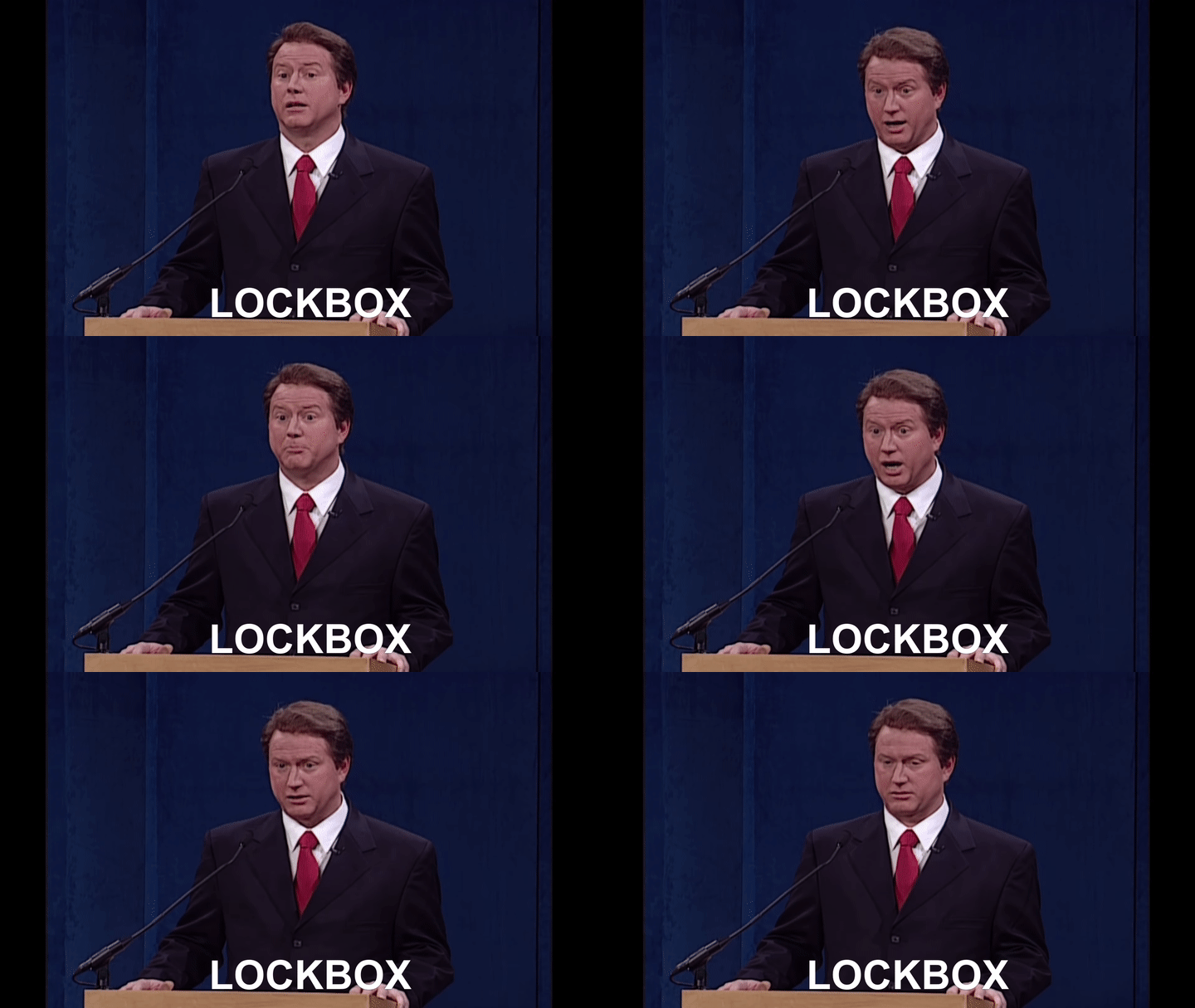
The sources cited above summarize that the SSA’s impending shortfall is caused by an aging population and changing demographics, and those are almost certainly contributing factors. It also must have been highly challenging when President Franklin Delano Roosevelt (FDR) worked with Congress to launch Social Security in 1935, and when President Lyndon Baines Johnson (LBJ) layered Medicare on top of it in 1965, to accurately forecast how long US residents would be living 50-100 years later; and how much to tax the citizenry to deliver these programs over time. But it is also worth taking a quick trip down Memory Lane to Al Gore’s “Lockbox” proposal in 2000, as memorialized by Darrell Hammond on Saturday Night Live. (Link will open to YouTube, so turn up your sound and enjoy.)
Gore’s plan was to create separate, protected accounts for Social Security and Medicare surpluses to ensure that these funds, by law, could be used only to strengthen those retirement programs and pay down the national debt, NOT to be looted by Congress for things like tax cuts. As alluded to in the social media posts, in the 25 years since Gore made that proposal, US taxpayers have been surprised to discover their money being used for things like paying hipsters to stop smoking, and to create holograms of comedians no longer living. Then in 2025, taxpayers were stunned to learn about the massive amounts of taxpayer money agencies like USAID were generously spending around the globe hoping the public would never find out on their behalf.
How much of this insanity siphoned money out of the SSA Trust Fund? Thanks to the web of intrigue woven into the Federal bureaucracy, we may never know. One thing is certain: These and innumerable other examples of out-of-control government spending—combined with the US National Debt, which at the time of this post now tops $38.5 TRILLION—appear to make it abundantly clear that Al Gore’s Lockbox, or something like it, is needed today more than ever.
A Modest Proposal: Allow citizens to opt out of Social Security
FDR established the Social Security Act, and LBJ, Medicare, to provide economic security and a safety net for vulnerable Americans, especially the elderly, and create a permanent system to prevent future crises by pooling resources. Sound, and arguably noble, reasoning all around. But if the Federal government ever fails to deliver on the promise of these programs, it would not only be one of the greatest abrogations of public trust in history, it might also cause an economic disaster in the US that could ripple around the world. The fact that policymakers around the Beltway are even hinting at the possibility should set off alarm bells.
The calculations above are based on the hypothetical example of a taxpayer earning an average of $30,000 per year throughout their career. The implications of the government defaulting on the broad swath of taxpayers with average career-long incomes far above that are staggering.
So is it time to allow US taxpayers to opt out of paying that 15.3% tax to the SSA? Here are my recommended elements should the nation choose to adopt an SSA Opt-Out plan:
- All money currently in a taxpayer’s SSA account would remain in place and, by law, untouched. The Federal government would commit to paying out no less than that full amount over the course of the citizen’s life, and that would remain true whether the citizen was in the SSA Opt-Out plan or not.
- To address an unspoken element of Social Security—the fear that not everyone will take steps to provide for their retirement, even if they have the means to do so—the SSA Opt-Out plan would require taxpayers to provide proof that they are contributing to their own retirement plan each year. If they failed to do so in any year, regardless of the reasons, they would be re-enrolled in Social Security and Medicare taxes beginning January 1 of the following year. Their contributions would begin accumulating on top of the existing money in their account.
- To ensure a sufficient safety net, the SSA would almost certainly have to set income-based minimum annual retirement savings amounts for taxpayers to maintain SSA Opt-Out eligibility year to year.
- Since SSA deductions are made on a pretax basis, discontinuing them would also increase taxable income for SSA Opt-Outs, and the Internal Revenue Service would have to make adjustments for those taxpayers to avoid negating the intent of the plan.
See how much you’ve paid into Social Security & Medicare, total, so far
The answer to this brewing crisis seems straightforward: For those who run the country to work together to preserve these vital programs before they hit a wall. And by “those who run the country,” I mean the media and the most popular TikTok influencers. Just kidding! I mean our duly elected representatives in the nation’s capital. The SSA Opt-Out plan could also ease the strain on the system while freeing taxpayers to invest more of their own money as a hedge against possible financial default of these programs.
In the meantime, you don’t have to guess or rely on hypothetical examples to see how much the government has taken from you and your employers for Social Security and Medicare whatever it decides to spend it on. You can download a PDF right now that shows exactly how much you have paid into each of these programs, and your projected monthly payout someday:
- Log into your SSA account at https://www.ssa.gov/.
- If you don’t have an account, create one today.
- It’s easy to find the document called Your Social Security Statement.
- Download that PDF, edit the filename to add today’s date, and save it (I’d recommend both on computer and in the cloud) so you know exactly what the figures were the day you saved it.
- When we downloaded ours today, the totals were through 2024, not yet 2025, which I suppose is to be expected of our eye-poppingly efficient Federal government just a few days into 2026.
If the Federal government ever tells the nation, “Sorry, we ran out of Social Security and Medicare,” we and of course everyone who has paid into these programs will be looking to recover every penny we contributed. Even at that, we would have lost a fortune in potential growth of principal if we had simply been allowed to invest it on our own.
 It Was Just a Thought™